
Basic regression in pytorch
import pandas as pd
import torch
import statsmodels.formula.api as smf
import statsmodels as sm
import seaborn as sns
import matplotlib.pyplot as plt

## Read in the data and display a few rows
dat = pd.read_csv("https://raw.githubusercontent.com/bcaffo/ds4bme_intro/master/data/oasis.csv")
dat.head(4)
Loading...
sns.scatterplot(x = dat['T2'], y = dat['PD'])<Axes: xlabel='T2', ylabel='PD'>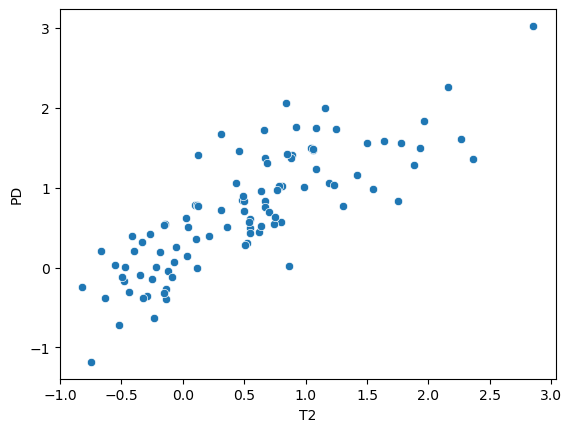
fit = smf.ols('PD ~ T2', data = dat).fit()
fit.summary()
Loading...
# The in sample predictions
yhat = fit.predict(dat['T2'])

# Make sure that it's adding the intercept
#test = 0.3138 + dat['T2'] * 0.7832
#sns.scatterplot(yhat,test)

## A plot of the in sample predicted values
## versus the actual outcomes
sns.scatterplot(x = yhat, y = dat['PD'])
plt.plot([-1, 3], [-1, 3], linewidth=2)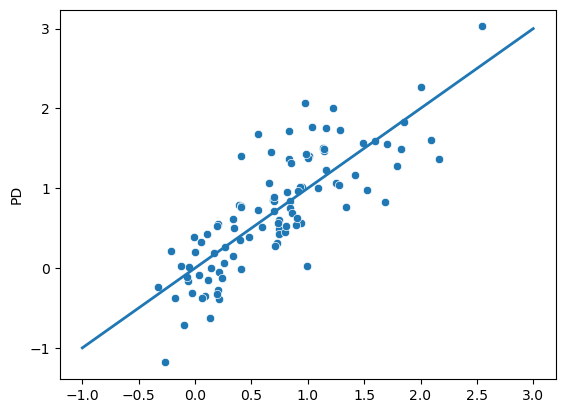
n = dat.shape[0]

## Get the y and x from
xtraining = torch.from_numpy(dat['T2'].values)
ytraining = torch.from_numpy(dat['PD'].values)

## PT wants floats
xtraining = xtraining.float()
ytraining = ytraining.float()

## Dimension is 1xn not nx1
## squeeze the second dimension
xtraining = xtraining.unsqueeze(1)
ytraining = ytraining.unsqueeze(1)

## Show that everything is the right size
[xtraining.shape,
 ytraining.shape,
 [n, 1]
 ]
[torch.Size([100, 1]), torch.Size([100, 1]), [100, 1]]## Show that linear regression is a pytorch
model = torch.nn.Sequential(
torch.nn.Linear(1, 1)
)
## MSE is the loss function
loss_fn = torch.nn.MSELoss(reduction='sum')
## Set the optimizer
## AdamW optimizer is often thought of as the best general purpose optimizer
optimizer = torch.optim.AdamW(model.parameters(), lr=1e-2)
## Loop over iterations
for t in range(10000):
## Forward propagation
y_pred = model(xtraining)
## the loss for this interation
loss = loss_fn(y_pred, ytraining)
#print(t, loss.item() / n)
## Zero out the gradients before adding them up
optimizer.zero_grad()
## Backprop
loss.backward()
## Optimization step
optimizer.step()
ytest = model(xtraining).detach().numpy().reshape(-1)
sns.scatterplot(x = ytest, y = yhat)
plt.plot([-1, 3], [-1, 3], linewidth=2);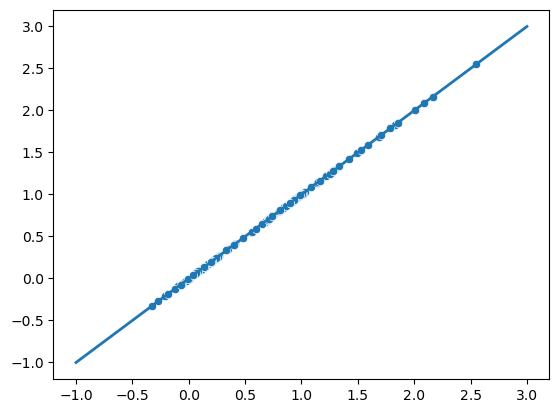
for param in model.parameters():
  print(param.data)
tensor([[0.7831]])
tensor([0.3138])