
Logistic regression in pytorch
This is an extension of using pytorch to perform linear regression to using it to perform logistic regression.
import pandas as pd
import torch
import statsmodels.formula.api as smf
import statsmodels as sm
import seaborn as sns
import matplotlib.pyplot as plt
import numpy as np

## Read in the data and display a few rows
dat = pd.read_csv("https://raw.githubusercontent.com/bcaffo/ds4bme_intro/master/data/oasis.csv")
dat.head(4)

## Create a binary outcome variable (people will use gold lesions in HW)
m = np.median(dat.T2)
dat = dat.assign(y = (dat.T2 > m) * 1 )
## Create a normalized regression variable
dat = dat.assign(x = (dat.PD - np.mean(dat.PD)) / np.std(dat.PD))
dat.head()
Loading...
fit = smf.logit('y ~ x', data = dat).fit()
fit.summary()
Optimization terminated successfully.
Current function value: 0.427855
Iterations 7
Loading...
# The in sample predictions
yhat = 1 / (1 + np.exp(-fit.fittedvalues))
n = dat.shape[0]
## Get the y and x from
xtraining = torch.from_numpy(dat['x'].values)
ytraining = torch.from_numpy(dat['y'].values)
## PT wants floats
xtraining = xtraining.float()
ytraining = ytraining.float()
## Dimension is 1xn not nx1
## squeeze the second dimension
xtraining = xtraining.unsqueeze(1)
ytraining = ytraining.unsqueeze(1)
## Show that everything is the right size
[xtraining.shape,
ytraining.shape,
[n, 1]
]
[torch.Size([100, 1]), torch.Size([100, 1]), [100, 1]]## Doing it more now the pytorch docs recommend
## Example taken from
## https://medium.com/biaslyai/pytorch-linear-and-logistic-regression-models-5c5f0da2cb9
## They recommend creating a class that defines
## the model
class LogisticRegression(torch.nn.Module):
def __init__(self):
super(LogisticRegression, self).__init__()
self.linear = torch.nn.Linear(1, 1, bias = True)
def forward(self, x):
y_pred = torch.sigmoid(self.linear(x))
return y_pred
## Then the model is simply
model = LogisticRegression()
## MSE is the loss function
loss_fn = torch.nn.BCELoss()
## Set the optimizer
optimizer = torch.optim.AdamW(model.parameters(), lr=1e-4)
## Loop over iterations
for t in range(100000):
## Forward propagation
y_pred = model(xtraining)
## the loss for this interation
loss = loss_fn(y_pred, ytraining)
#print(t, loss.item() / n)
## Zero out the gradients before adding them up
optimizer.zero_grad()
## Backprop
loss.backward()
## Optimization step
optimizer.step()
ytest = model(xtraining)
ytest = ytest.detach().numpy().reshape(-1)
plt.plot(yhat, ytest,  ".")
plt.plot([0, 1], [0, 1], linewidth=2)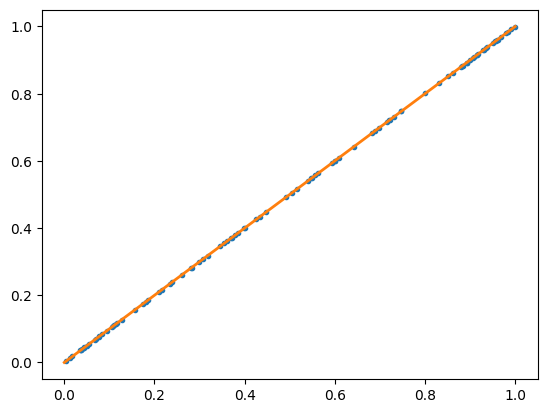
for param in model.parameters():
  print(param.data)
tensor([[2.2226]])
tensor([0.0367])